New National Coalition Launches in Ottawa to Unite Canada's Nuclear Medicine Ecosystem Around Patients
Canada NewsWire
OTTAWA, ON, Oct. 5, 2026
The National Coalition for Nuclear Medicine Council is Canada's only organization connecting physicians, technologists, industry, educators, governments, and patients across the full ecosystem
OTTAWA, ON, Oct. 5, 2026 /CNW/ -- Every day, Canadians facing cancer, heart disease, and other serious illness depend on nuclear medicine for the scan that finds the problem and, increasingly, for the therapy that treats it. The people who make that care possible work across many separate organizations, and until now no single table has brought them all together. On Saturday in Ottawa, that changed with the launch of the National Coalition for Nuclear Medicine Council (NCNMC).
The NCNMC was officially launched on October 3, 2026, during the Canadian Association of Nuclear Medicine (CANM) 2026 Annual Conference at the Fairmont Château Laurier. Mina Bechai, Founder and Chair of the NCNMC, and Dr. François Lamoureux, President of the CANM, launched it together. A federal not-for-profit, the Coalition is the first Canadian organization built across the full nuclear medicine value chain, from isotope production to patient outcomes.
Nuclear medicine uses tiny amounts of radioactive material to show how the body is working, not just what it looks like. It tells a care team whether a cancer has spread, whether a heart is getting the blood it needs, and whether a treatment is working. Increasingly, it also treats cancer directly, and those new radioligand therapies are emerging faster than Canada's nuclear medicine ecosystem can absorb them.
The pressures are well documented. A national White Paper published by the CANM describes an aging technologist workforce, limited training capacity, and small teams in several provinces, where a single departure can interrupt service. It projects that technologists will retire faster than Canada can train replacements. Nuclear medicine is also not yet part of national wait-time reporting.
Canadian nuclear medicine is organized in verticals. Physicians, technologists, isotope producers, industry, educators, regulators, and provincial health ministries each have their own organizations, mandates, and data. Each does essential work, but they work in silos, and no single body is built to see the whole ecosystem. Yet a single scan crosses every one of those lines: the isotope is produced by one organization, prepared and administered by a technologist, read by a physician, and funded by a province. The NCNMC is the horizontal platform that connects them. It does not replace any existing association or industry body. It links the vertical organizations to one another, and to patients, the public, and students, around the same data.
The Coalition is built on three principles. Transparency means publishing what is not published today, from workforce data and wait times to isotope supply and funding pathways, in both official languages. Awareness means closing the gap between what insiders know and what the public understands. Accountability means turning that awareness into concrete commitments from governments, regulators, payers, and the profession, and measuring progress in the open.
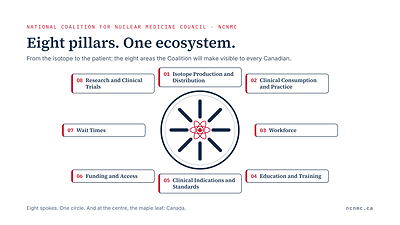
The first tool is the National Nuclear Medicine Dashboard, a public resource now in development that will report on workforce, wait times, isotope supply, and access. In its first year, the Coalition also plans to publish a National State of Nuclear Medicine Report, announce its founding Board of Directors, and convene advisory committees on each of its eight pillars.
The Coalition grew out of the CANM's White Paper, "Canada's Nuclear Medicine Technologist Workforce Shortage Crisis," which was presented at the association's 2025 conference in Halifax, 11 months before the launch. The White Paper recommended establishing the NCNMC as a national coordinating body. The Coalition's mandate extends that recommendation beyond the workforce to isotope supply, education, access, wait times, funding, and research.
"Any one of us could be the next patient. Our goal isn't to point fingers: it's to identify the gaps and bridge them, together," said Mina Bechai, Founder and Chair of the NCNMC. "The people in this ecosystem are working with remarkable dedication, and every organization in it does essential work. The gaps are not inside those organizations. They are in the spaces between them. Our role is to connect the people doing the work, make the invisible visible, and keep the patient at the centre of every conversation."
"Nuclear medicine is advancing quickly in Canada, in both diagnostics and theranostics, and every patient in every province deserves to benefit," said Dr. François Lamoureux, President of the CANM. "The pressures on our workforce and our training programs are well known to everyone in this field, and no single organization can resolve them alone. What has been missing is one table where physicians, technologists, educators, governments, industry, and patients can work from the same information. The Coalition is that table. I am proud to help launch it here in Ottawa, at our annual conference."
"To solve a problem, you have to understand it. To understand it, you have to know about it," Bechai said. "Transparency creates awareness. Awareness creates the accountability that drives change."
About the NCNMC
The National Coalition for Nuclear Medicine Council (NCNMC), in French the Coalition nationale pour le Conseil de médecine nucléaire, is a Canadian federal not-for-profit corporation dedicated to identifying and bridging the systemic gaps in Canada's nuclear medicine ecosystem. It operates on three principles: transparency, awareness, and accountability. Its mandate spans eight pillars: isotope production and distribution, clinical consumption and practice, workforce, education and training, clinical indications and standards, funding and access, wait times, and research and clinical trials. The NCNMC works in both official languages and engages patients, the general public, students, professionals, policymakers, industry, and academia.
SOURCE The National Coalition for Nuclear Medicine Council

