Retail CIOs Risk Wasted AI Spend Without Data Flow Visibility Across the Technology Stack, Finds Info-Tech Research Group
Canada NewsWire
ARLINGTON, Va., May 6, 2026
As retailers race to apply AI across operations, customer experience, and the supply chain, fragmented point solutions and disconnected data continue to limit execution. Info-Tech Research Group's newly published blueprint, Build a Next-Gen Retail Tech Stack Roadmap, outlines a practical framework to help CIOs align business capabilities with core systems, identify modernization gaps, and build an AI-ready retail roadmap from warehouse to checkout.
ARLINGTON, Va., May 6, 2026 /CNW/ - Retailers are under growing pressure to use AI to improve operations, personalize customer engagement, strengthen supply chain visibility, and modernize the path from warehouse to checkout. However, many organizations are attempting to scale AI on top of fragmented technology environments that lack the coherence, data quality, and architectural visibility needed to turn innovation into measurable value. To help CIOs and retail IT leaders address these barriers, Info-Tech Research Group has published its Build a Next-Gen Retail Tech Stack Roadmap blueprint, a resource designed to help organizations map their current technology landscape, identify modernization priorities, and build a roadmap that connects technology investments to business outcomes.
Info-Tech's findings show that modern retailers often operate within sprawling ecosystems of point solutions, each promising efficiency or innovation but collectively increasing complexity when implemented without a shared architectural foundation. As departments adopt systems independently, leaders lose visibility into integration, security, spend, and data flows. This fragmentation makes it difficult to establish a single source of truth, prove ROI on AI investments, and determine which systems should be maintained, enhanced, redesigned, or transformed.
"CIOs face a paradox where technology is more abundant than ever, yet digital coherence has never been harder to achieve," says Donnafay MacDonald, research director at Info-Tech Research Group. "Retailers will not solve fragmentation by adding another tool. They need to understand what they already have, how it connects, and where it falls short before they can build the foundation for intelligent, connected retail."
Key Barriers Slowing Retail Tech Stack Adoption
The firm's research highlights several recurring challenges that prevent retailers from modernizing with confidence and scaling AI effectively, including:
- Disconnected point solutions that obscure the overall architecture and make it harder to see how systems support business capabilities.
- Limited visibility into integration, security, spend, and data as departments select tools independently.
- The absence of a single source of truth, which blocks analytics maturity and limits AI readiness.
- Difficulty proving ROI when system investments are not clearly linked to measurable business outcomes.
- Legacy dependence, outdated asset inventories, and short-term fixes that delay modernization and increase technical debt.
The global research and advisory firm emphasizes that modernizing the retail tech stack requires agreement across the business, not only new technology. Without alignment on business outcomes, architecture principles, and the systems that support priority capabilities, retailers risk adding more tools without improving how the environment works.
Info-Tech's Three-Phase Roadmap for Building a Next-Gen Retail Tech Stack
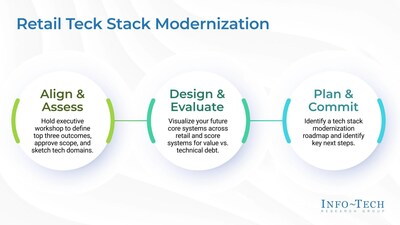
The Build a Next-Gen Retail Tech Stack Roadmap blueprint details a structured, three-phase methodology to help CIOs and retail IT leaders turn fragmented technology landscapes into actionable modernization plans:
Phase 1: Align and Assess
Executive and IT leaders define the vision, desired business outcomes, and top modernization goals. Teams review capability gaps identified through the retail business reference architecture and sketch the current tech stack to understand which systems support priority business capabilities.
Phase 2: Design and Evaluate
Retail organizations sketch the future-state technology landscape, identify the core enabling technologies needed to close capability gaps, and score applications across key layers, including experience and engagement, operations, integration and automation, data, analytics and AI, infrastructure, and security.
Phase 3: Plan and Commit
Teams translate heatmap results and modernization priorities into a sequenced roadmap. This step helps leaders assess timing, dependencies, risk, business value, and the action required for each system, whether to maintain, enhance, redesign, or transform.
The blueprint also includes the Build a Next-Gen Retail Tech Stack Tool, which consolidates capability assessments, core technology inventories, current- and future-state sketches, application heatmaps, modernization timing, and key commitments into a single actionable view. The resource is designed to help teams move from anecdotal debates about systems to a shared, data-driven understanding of where technology delivers value, where risk accumulates, and where modernization will have the greatest business impact.
"Retail CIOs do not need another long-range transformation plan that stalls before value is realized," explains MacDonald. "They need a focused way to clarify what the business needs, understand the systems that enable those capabilities, and move forward with a roadmap that balances quick wins with long-term scalability."
By applying the firm's methodology outlined in the Build a Next-Gen Retail Tech Stack Roadmap blueprint, retail organizations can improve portfolio visibility, reduce redundancy, strengthen decision confidence, and create a clearer connection between technology modernization and business value. The result is a more coherent foundation for AI-enabled retail, helping leaders make smarter investment decisions and build a technology environment that can adapt as customer expectations, operational demands, and AI capabilities continue to evolve.
For exclusive and timely commentary from Info-Tech's experts, including Donnafay MacDonald, and access to the complete Build a Next-Gen Retail Tech Stack Roadmap blueprint, please contact pr@infotech.com.
About Info-Tech Research Group
Info-Tech Research Group is the "get things done" partner for over 30,000 IT, HR, and marketing leaders worldwide. The fastest growing research and advisory firm, Info-Tech enables leaders to make well-informed decisions and transform their organizations through AI, strategic foresight, step-by-step methodologies, practical tools, industry-leading advisory, and training programs. For nearly 30 years, tens of thousands of private and public organizations have trusted Info-Tech to lead their most important initiatives through periods of change and deliver outcomes that truly matter.
To learn more about Info-Tech's HR research and advisory services, visit McLean & Company, and for data-driven software buying insights and vendor evaluations, visit the firm's SoftwareReviews platform.
Media professionals can register for unrestricted access to research across IT, HR, and software, and hundreds of industry analysts through the firm's Media Insiders program. To gain access, contact pr@infotech.com.
For information about Info-Tech Research Group or to access the latest research, visit infotech.com and connect via LinkedIn and X.

 View original content to download multimedia:https://www.prnewswire.com/news-releases/retail-cios-risk-wasted-ai-spend-without-data-flow-visibility-across-the-technology-stack-finds-info-tech-research-group-302764509.html
SOURCE Info-Tech Research Group

